

The Crisis of Reality: Securing Identity in the Age of the Deepfake
Introduction
In 2026, the old adage “seeing is believing” has officially been retired. We have entered an era where high-fidelity synthetic media—commonly known as Deepfakes—can mimic human voice, facial expressions, and physiological ticks with 99% accuracy.
For the modern enterprise, this isn’t just a social concern; it is a critical security vulnerability. As deepfakes move from social media novelties to weaponized tools for corporate espionage and financial fraud, the race to secure digital identity has become the new frontline of cybersecurity.
1. The Anatomy of a Modern Deepfake Attack
Traditional phishing relied on deceptive text. The new wave of “Business Identity Compromise” (BIC) utilizes Generative Adversarial Networks (GANs) to create real-time video and audio clones.
The “Virtual CEO” Fraud
We are seeing a surge in sophisticated “Man-in-the-Middle” attacks during high-stakes video calls. Attackers use real-time face-swapping software to impersonate a CEO or CFO during a Zoom or Teams meeting, instructing subordinates to authorize emergency wire transfers or leak sensitive credentials. Because the “boss” looks and sounds exactly like themselves—even down to the specific background of their home office—the success rate of these attacks is alarmingly high.
Biometric Bypassing
Facial recognition and voice authentication were once considered the “Gold Standard” of Multi-Factor Authentication (MFA). Deepfakes have turned these into liabilities. Advanced synthetic masks can now “spoof” 2D and even some 3D facial recognition systems, allowing attackers to unlock secured mobile devices and enterprise portals.
Generative adversarial networks for AI image recognition outline diagram
2. Defensive Frontiers: “Live-ness” Detection
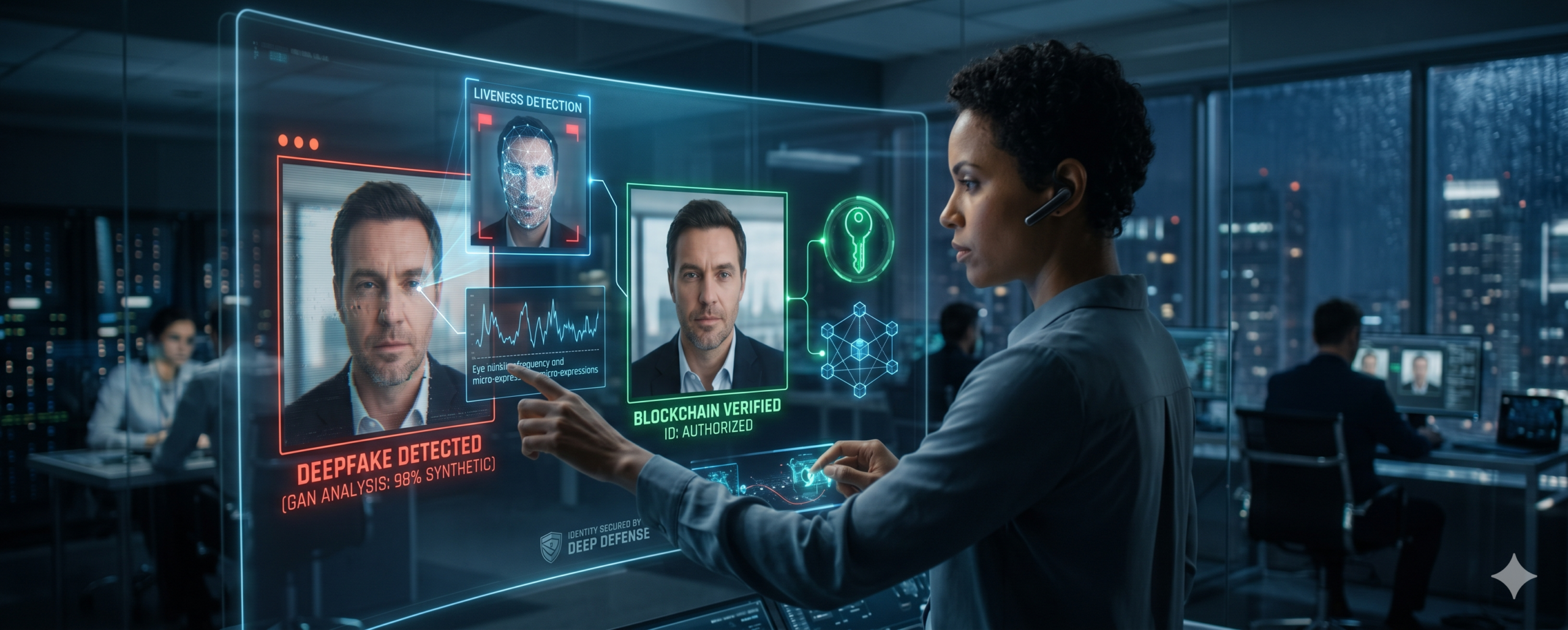
To combat synthetic media, security teams are deploying Active and Passive Liveness Detection. These systems are designed to prove that the person on the other side of the lens is a living, breathing human, not a digital projection.
Micro-Expression and Texture Analysis
Defensive AI now scans for “digital artifacts” that the human eye cannot see. This includes:
- Blood Flow Visualization: Sophisticated sensors can detect the subtle change in skin color (photoplethysmography) that occurs with a human heartbeat—something deepfakes cannot yet replicate in real-time.
- Ocular Inconsistencies: AI monitors the way light reflects off the cornea and the frequency of natural, involuntary blinking patterns.
- Phoneme-Viseme Mismatch: The system analyzes the micro-sync between the sound produced (phoneme) and the physical movement of the mouth (viseme). If there is even a millisecond of lag, the identity is flagged.
3. The Blockchain Solution: Verified Digital Identities
The most robust defense against deepfakes is moving away from “visual trust” and toward Cryptographic Trust.
Decentralized Identifiers (DIDs)
Instead of relying on a video feed to prove who you are, organizations are implementing Blockchain-Verified Digital Identities. In this model, every employee holds a unique, encrypted private key on a secure hardware module (like a YubiKey or a mobile Secure Enclave).
When a CEO joins a call, the platform automatically performs a background cryptographic handshake. If the video stream isn’t signed by the CEO’s unique private key on the blockchain, a “Unverified Identity” warning appears over the video, regardless of how “real” the person looks.
4. Building a “Zero Trust” Culture for Identity
Technology alone cannot solve the deepfake crisis. Professional teams must implement new protocols to safeguard their operations:
- Out-of-Band Verification: For any high-value transaction or sensitive data request initiated via video, a secondary verification through a different channel (e.g., an encrypted messaging app or a physical token) should be mandatory.
- The “Challenge Response” Method: During suspicious calls, employees are trained to ask the speaker to perform an unusual action, such as turning their head 90 degrees or waving a hand in front of their face. Most real-time deepfake algorithms still struggle with extreme angles and “occlusion” (when something passes in front of the face).
- Continuous Authentication: Moving away from “one-time login” toward a system that constantly verifies the user’s biometrics and behavior throughout the entire session.
Conclusion: Securing the Human Element
As the barrier between digital and physical reality dissolves, the definition of “Identity” is being rewritten. We can no longer trust our eyes; we must trust our math.
By combining Real-time Liveness Detection with Blockchain-backed Cryptographic Proof, professional teams can build a shield that is deepfake-proof. At the end of the day, security in 2026 is about ensuring that the person you see on your screen is not just a ghost in the machine, but a verified, authenticated human being.