
Beyond the Password: Building a Human Firewall with Cognitive Security
In the cybersecurity world of 2026, we have achieved near-perfection in technical controls. Our AI-driven firewalls are faster than ever, and our encryption is mathematically “unbreakable.” Yet, breaches continue to occur. Why? Because hackers have realized it is far easier to hack a human mind than a high-end server.
The industry is now pivoting toward Cognitive Security. This isn’t just “security awareness training”; it is a sophisticated application of psychology and behavioral science designed to turn the “weakest link” into an organization’s most intelligent sensor.
1. The Psychology of the Phish: Why We Fall for It
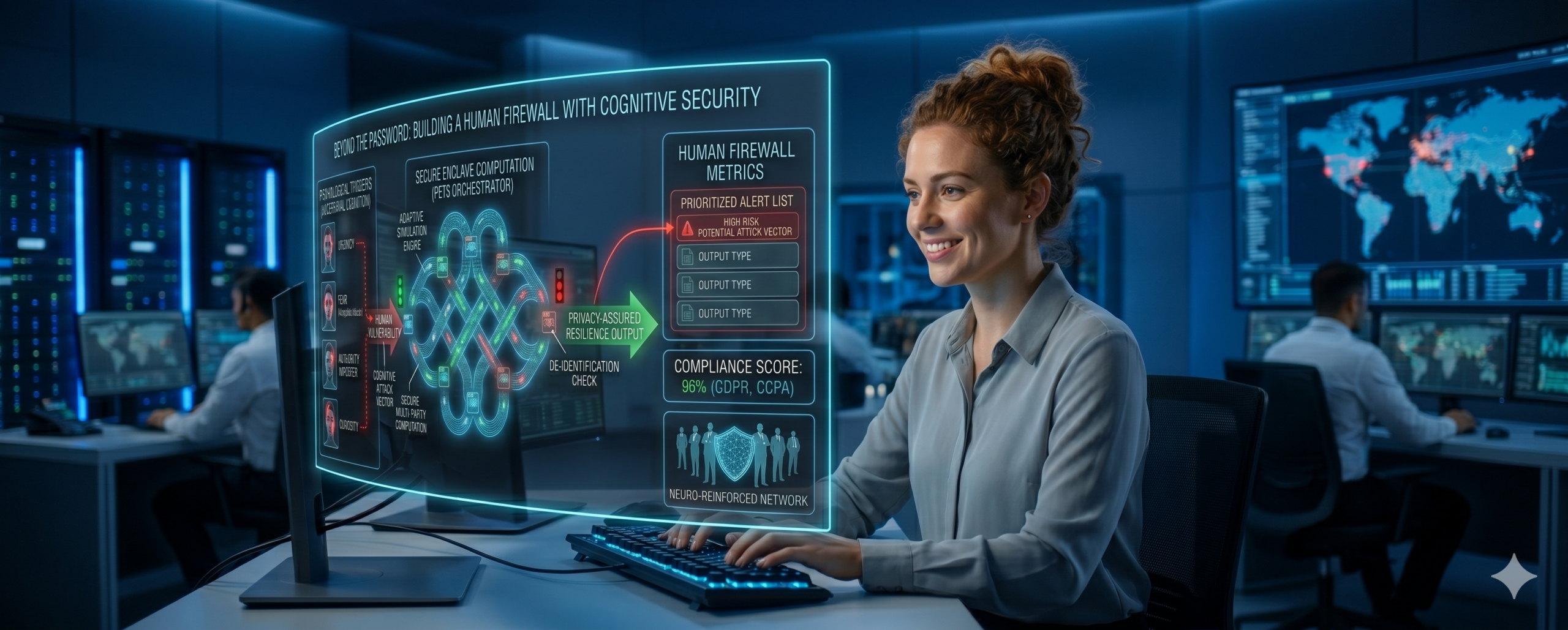
Hackers are no longer just “coders”; they are “social engineers” who exploit universal human cognitive biases. Cognitive security begins by identifying the four primary psychological triggers used in modern attacks:
- Urgency & Fear: “Your account will be deleted in 10 minutes.” This triggers the Amygdala Hijack, bypassing the logical brain and forcing a panic-driven click.
- Authority: Impersonating a CEO or a government official to exploit our natural tendency to obey hierarchy.
- Social Proof: “All your colleagues have already signed this document.” We are wired to follow the herd.
- Curiosity & Reciprocity: Exploiting our natural desire to help or discover new information.
2. What is Cognitive Security?
Cognitive Security is the practice of using AI to understand how humans process information and using that data to prevent manipulation. It creates a feedback loop between human behavior and technical defense.
Adaptive Behavioral Simulations
Traditional security training involves a generic video and a quiz once a year. Cognitive Security uses AI to create Adaptive Simulations. If an employee consistently clicks on “Urgent” emails but ignores “Authority-based” ones, the system recognizes this pattern. It will then automatically increase the frequency of “Urgency” simulations for that specific person until their cognitive resistance improves.
Real-Time Nudges
Imagine an employee is about to click a suspicious link. A Cognitive Security tool doesn’t just block it; it provides a “Nudge”—a brief, context-aware notification that explains why the link is suspicious (e.g., “The sender’s domain is 95% similar to our corporate domain but has one letter swapped”). This turns a potential mistake into a “teachable moment” in real-time.
3. The “Human Firewall” Framework
To build a true human firewall, professional teams must move from “Compliance” to “Culture.” This involves three distinct layers:
Layer 1: Emotional Intelligence (EQ) Training
We teach employees to recognize their own physical and emotional responses to a digital message. If their heart starts racing or they feel a sudden sense of panic, that is the first “red flag” of a cyberattack. We train them to “Stop, Breathe, and Verify.”
Layer 2: Gamified Defense
By turning security into a collaborative game, organizations can increase engagement. Teams that report the most “simulated” phishes earn rewards. This shifts the perception of security from a “burden” to a “team sport.”
Layer 3: Cognitive Load Management
A tired or overwhelmed employee is a security risk. Cognitive Security monitors “Security Fatigue.” If a user has been bombarded with complex tasks all day, the system can temporarily increase technical restrictions on their account, knowing they are statistically more likely to make a cognitive error during high-stress periods.
4. The Future: AI-Human Symbiosis
By 2027, we expect to see Digital Twins of Human Behavior. These models will allow security teams to predict which departments or roles are most likely to be targeted by specific psychological campaigns.
For instance, the Accounting department might be more susceptible to “Authority” triggers during tax season, while the Sales team might be more vulnerable to “Curiosity” triggers during a product launch. Cognitive Security allows us to deploy “psychological armor” exactly where and when it is needed most.
Conclusion: The Mind is the Ultimate Perimeter
Technology is the skeleton of cybersecurity, but the human element is the nervous system. You can have the most expensive firewall in the world, but it only takes one person in a moment of stress to hand over the keys to the kingdom.
At RTC, we believe that true security starts with the person in the chair. By implementing Cognitive Security strategies, we help you build a workforce that isn’t just “aware” of threats—but is psychologically resilient against them. We turn your employees into your most powerful defensive asset, ensuring that your “Human Firewall” is just as unhackable as your digital one.
Strategy for Your HR & Security Teams:
- Personalized Training: Stop using “one-size-fits-all” training. Tailor it to individual behavioral profiles.
- Positive Reinforcement: Reward the “Reporting” of threats rather than punishing the “Clicking” of links.
- Stress Monitoring: Acknowledge that “Security Fatigue” is a real technical vulnerability.
- Continuous Feedback: Move from annual training to “micro-learning” integrated into the daily workflow.