

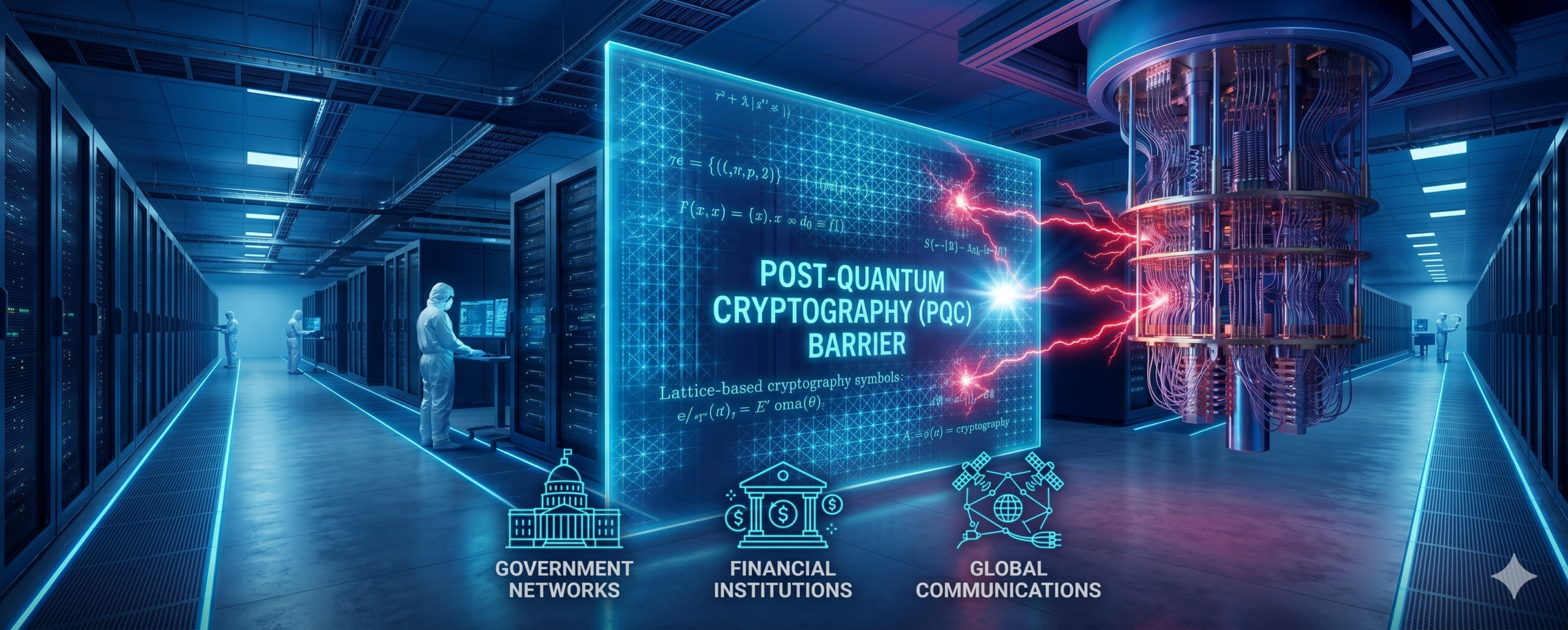
The Quantum Countdown: A Definitive Guide to Post-Quantum Cryptography (PQC)
Executive Summary: The “Q-Day” Reality
For decades, the security of the global economy has rested on a simple mathematical bet: that certain problems, like factoring large prime numbers, are too difficult for computers to solve. Quantum computing is about to win that bet.
We are approaching “Q-Day”—the moment a cryptographically relevant quantum computer (CRQC) becomes capable of shattering RSA and ECC encryption in seconds. For government agencies and financial institutions, the clock isn’t just ticking; it’s screaming. This guide explores why we must migrate to Post-Quantum Cryptography (PQC) today to defend against the threats of tomorrow.
A. Understanding the Quantum Threat
Shor’s Algorithm and the End of RSA
Traditional encryption relies on the limits of classical physics. RSA encryption, for instance, uses the product of two massive prime numbers as a key. A classical supercomputer would take trillions of years to crack it.
However, Shor’s Algorithm, running on a sufficiently powerful quantum computer, can solve these problems almost instantaneously. This renders nearly all current public-key infrastructure (PKI) obsolete, from HTTPS web traffic to the digital signatures securing the global blockchain.
The “Harvest Now, Decrypt Later” (HNDL) Attack
The most urgent reason for immediate PQC adoption is HNDL. State actors and sophisticated cyber-syndicates are currently intercepting and storing vast amounts of encrypted sensitive data (government communications, medical records, trade secrets).
They cannot read it today. But they are betting that in 5 to 10 years, they will have the quantum power to decrypt it. If your data needs to remain secret for 10+ years, it is already at risk.
B. What is Post-Quantum Cryptography?
Defining the Shield
Contrary to popular belief, PQC is not “Quantum Cryptography” (which requires quantum hardware). PQC refers to classical mathematical algorithms—run on standard computers—that are specifically designed to be resistant to quantum attacks.
The NIST Selection Process
Since 2016, the National Institute of Standards and Technology (NIST) has been evaluating algorithms to find the “Gold Standard” for the PQC era. The leading candidates are based on:
- Lattice-based Cryptography: Problems involving finding the shortest vector in a high-dimensional grid.
- Code-based Cryptography: Relying on the difficulty of decoding general linear codes.
- Multivariate Quadratic Equations: Using systems of non-linear equations.
C. Critical Sectors at Risk
1. Government and Defense
National security depends on “Cover Time”—the duration for which a secret must remain a secret. If a diplomatic cable sent today is decrypted in 2030, the geopolitical fallout could be catastrophic. This is why the U.S. government issued the Quantum Computing Cybersecurity Preparedness Act.
2. Financial Institutions
The banking sector relies on digital signatures for trillions of dollars in daily transactions. If an attacker can forge a signature using a quantum computer, the entire foundation of digital trust in the financial system collapses.
3. Critical Infrastructure
Power grids and water systems use embedded devices with long lifespans (15–20 years). If these devices aren’t updated to PQC now, they will be vulnerable for the duration of their operational life.
D. The Roadmap to Quantum Resilience
Step 1: Crypto-Agility
Organizations must move toward Crypto-Agility—the ability to swap out encryption algorithms without overhauling the entire system. This involves moving away from hard-coded encryption and toward modular security architectures.
Step 2: The Inventory Phase
You cannot protect what you don’t know you have. Organizations must audit their entire tech stack to identify every instance of RSA, Diffie-Hellman, and Elliptic Curve cryptography currently in use.
Step 3: Hybrid Implementation
The transition won’t happen overnight. Most experts recommend a Hybrid Approach: using a combination of a classical algorithm (for current security) and a PQC algorithm (for future security) within the same connection.
E. Challenges in the PQC Migration
- Key Size Issues: PQC keys and signatures are significantly larger than traditional ones. This can lead to increased latency and require hardware upgrades for servers.
- Performance Overhead: Some PQC algorithms require more computational power, which could impact the battery life of mobile and IoT devices.
- Standardization Lag: While NIST has announced winners (like CRYSTALS-Kyber and CRYSTALS-Dilithium), integrating these into global protocols like TLS 1.3 and SSH takes years of coordination.
Conclusion: The Time to Act is Yesterday
The transition to Post-Quantum Cryptography is perhaps the largest “rip-and-replace” event in the history of information technology. It is more complex than Y2K because it involves fundamental changes to how we verify identity and secure data.
For those in leadership, the message is clear: Wait and see is not a strategy. By the time a quantum computer is officially announced, your harvested data will already be compromised. True professional teams are building quantum-resistant walls today.