

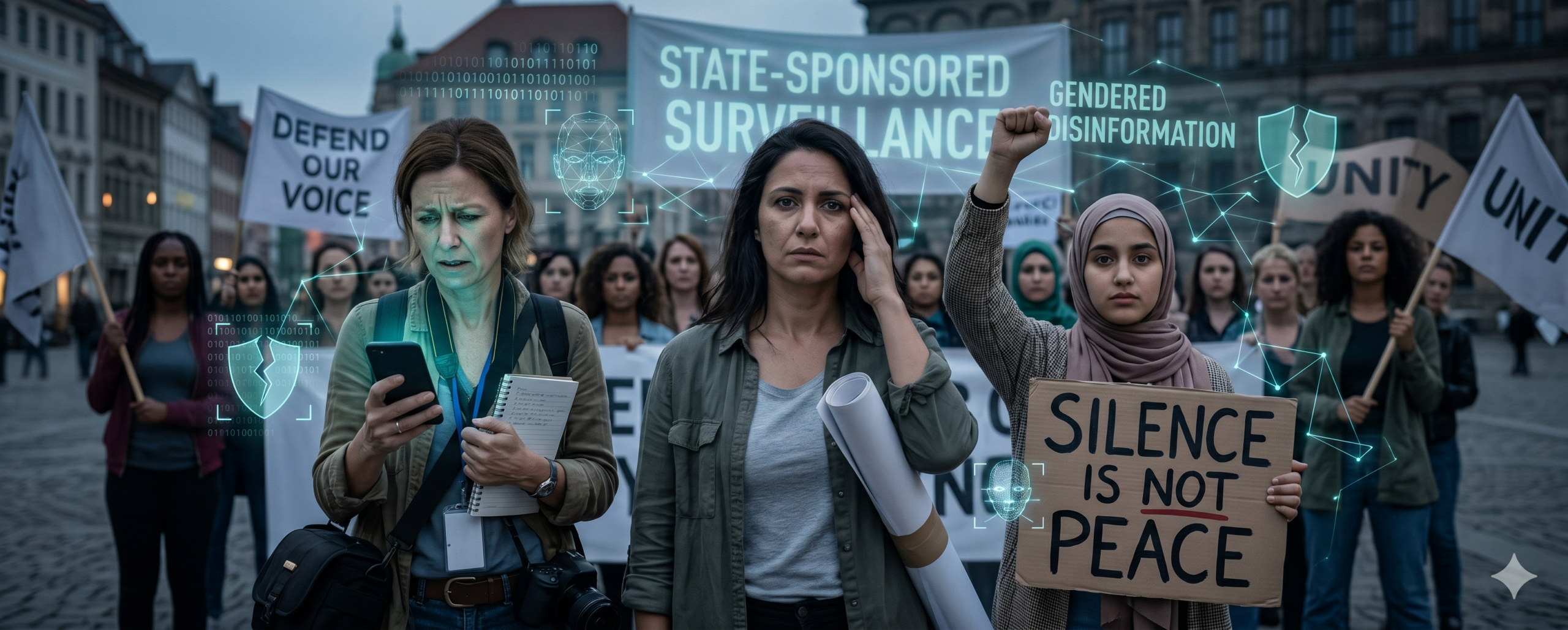
The Price of a Voice: Cyber Warfare Against Women Human Rights Defenders and Journalists
The digital age promised unprecedented democratization of information and a global platform for marginalized voices. For Women Human Rights Defenders (WHRDs), journalists, and political leaders, the internet has been a vital tool for organizing, reporting, and leading. However, this same digital landscape has rapidly transformed into a hostile battleground.
Today, women in public-facing roles are not just encountering casual online harassment; they are facing severe, highly organized, and well-funded cyber threats. These campaigns are explicitly designed with a singular, chilling goal: to silence female voices, discredit their authority, and drive them out of the public sphere entirely.
This article examines two of the most insidious tactics used in this digital warfare: the deployment of state-sponsored surveillance and the orchestration of gendered disinformation campaigns.
Part 1: The Chilling Reach of State-Sponsored Surveillance
When we discuss cyber threats against individuals, we often think of financial scams or identity theft. However, for female journalists reporting on corruption or activists organizing against authoritarian regimes, the threat model is vastly different. They are increasingly the targets of nation-states and powerful malicious actors wielding military-grade cyber weapons.
The Rise of Mercenary Spyware
The proliferation of commercial spyware, most notably NSO Group’s Pegasus, has fundamentally altered the safety landscape for women in public life. Unlike traditional malware that requires a target to click a malicious link (phishing), advanced spyware often utilizes “zero-click” exploits. This means a device can be compromised simply by receiving a missed call on WhatsApp or an invisible iMessage, requiring no interaction from the victim whatsoever.
Once installed, this software grants the attacker god-level access to the device. They can track real-time GPS locations, extract encrypted messages from apps like Signal or Telegram, record phone calls, and silently activate the device’s camera and microphone.
The Gendered Weaponization of Data
While male activists and journalists are also targeted by spyware, the extraction of data is distinctly weaponized against women. In many societies, a woman’s reputation is unfairly tied to her “honor,” modesty, or private life.
State-sponsored actors understand this societal vulnerability. When a female activist’s phone is hacked, the goal is often to mine the device for intimate photographs, private conversations, or details about her sexual orientation or personal relationships. This stolen data is then used for blackmail, coercion, or catastrophic public smear campaigns. The threat is clear: cease your work, or your private life will be destroyed. For many WHRDs operating in conservative or authoritarian regions, this kind of exposure is not just professionally ruinous; it is physically life-threatening.
Part 2: The Machinery of Gendered Disinformation
While surveillance operates in the shadows, disinformation campaigns operate in the glaring spotlight of social media. Disinformation—the deliberate creation and spread of false information—is a known political tool. However, when directed at women in leadership, it takes on a highly specific, toxic form known as gendered disinformation.
Targeting Identity Over Policy
Standard political attacks might critique a leader’s voting record or economic policies. Gendered disinformation, by contrast, rarely engages with a woman’s actual work. Instead, it relies on deeply entrenched misogynistic tropes to attack her identity, credibility, and right to hold power.
Common narratives in these campaigns include:
- Hyper-sexualization: Circulating manipulated images (deepfakes) or fabricating stories about a woman’s sexual history to demean her and distract from her professional expertise.
- Questioning Sanity and Stability: Framing female leaders as “hysterical,” “overly emotional,” or mentally unfit for the pressures of public office or investigative journalism.
- Attacking Maternal Fitness: Discrediting women by questioning their ability to balance their public roles with family life, framing them as “bad mothers” or unnaturally ambitious.
Coordinated Inauthenticity
These are rarely organic expressions of public distaste. Gendered disinformation campaigns are typically coordinated operations. They are often fueled by state-backed troll farms, bot networks, and algorithmic manipulation.
A malicious actor might seed a fabricated, degrading rumor about a female journalist on a fringe forum. Bot networks then amplify this rumor across platforms like X (formerly Twitter), Facebook, and TikTok, pushing it into the trending algorithms. Within hours, the target is overwhelmed by thousands of abusive messages, death threats, and rape threats from both automated accounts and radicalized real users.
The objective is twofold: to destroy the woman’s credibility in the eyes of the public, and to exhaust her psychologically until she self-censors or resigns.
Part 3: The Democratic Deficit and Real-World Consequences
The consequences of these targeted attacks extend far beyond the individual victims; they pose a severe threat to global democracy and human rights.
The “Chilling Effect” and Self-Censorship
The psychological toll of enduring constant, organized digital violence is immense. Faced with the persistent threat of having their devices hacked, their private lives exposed, and their reputations destroyed by fabricated scandals, many women make the agonizing decision to step back.
They may stop reporting on controversial topics, delete their social media profiles, choose not to run for political office, or abandon their activism entirely. This creates a profound “chilling effect.” The public square becomes sanitized of female perspectives, particularly the voices of women of color and LGBTQ+ women, who often face intersectional, compounded forms of this abuse.
Escalation to Physical Violence
It is a dangerous misconception to view cyber violence as entirely separate from physical violence. For women in public-facing roles, the digital and physical worlds are inextricably linked. Coordinated disinformation campaigns routinely incite real-world mobs, and the location tracking enabled by spyware has been directly linked to the physical surveillance, kidnapping, and assassination of journalists and activists globally.
Part 4: Building Institutional Resilience
Solving the crisis of targeted digital attacks against women requires shifting the burden of protection away from the individual targets and onto institutions, tech companies, and governments.
- Regulating the Spyware Industry: There must be immediate, enforceable international regulations on the sale and deployment of commercial spyware. Governments that abuse these tools to target journalists and WHRDs must face severe diplomatic and economic sanctions.
- Platform Accountability: Social media platforms must move beyond reactive content moderation. They need to proactively identify and dismantle coordinated bot networks and troll farms that drive gendered disinformation. Algorithms must be adjusted so they do not reward and amplify inflammatory, misogynistic content for the sake of “engagement.”
- Digital Security Infrastructure: Media organizations, political parties, and human rights NGOs must provide their female staff with robust, ongoing digital security training. This includes institutional support for secure hardware, threat modeling, and access to psychological support for those targeted by digital violence.
Conclusion
The targeting of Women Human Rights Defenders and journalists through state-sponsored surveillance and gendered disinformation is not just a technology problem; it is a deliberate tactic of patriarchal control and authoritarianism. When we allow the digital public square to become a hostile, dangerous environment for women, we lose vital investigators, passionate advocates, and capable leaders. Protecting women against organized cyber warfare is not a niche feminist issue; it is a fundamental prerequisite for maintaining a free press, human rights, and a functioning democracy in the 21st century.