

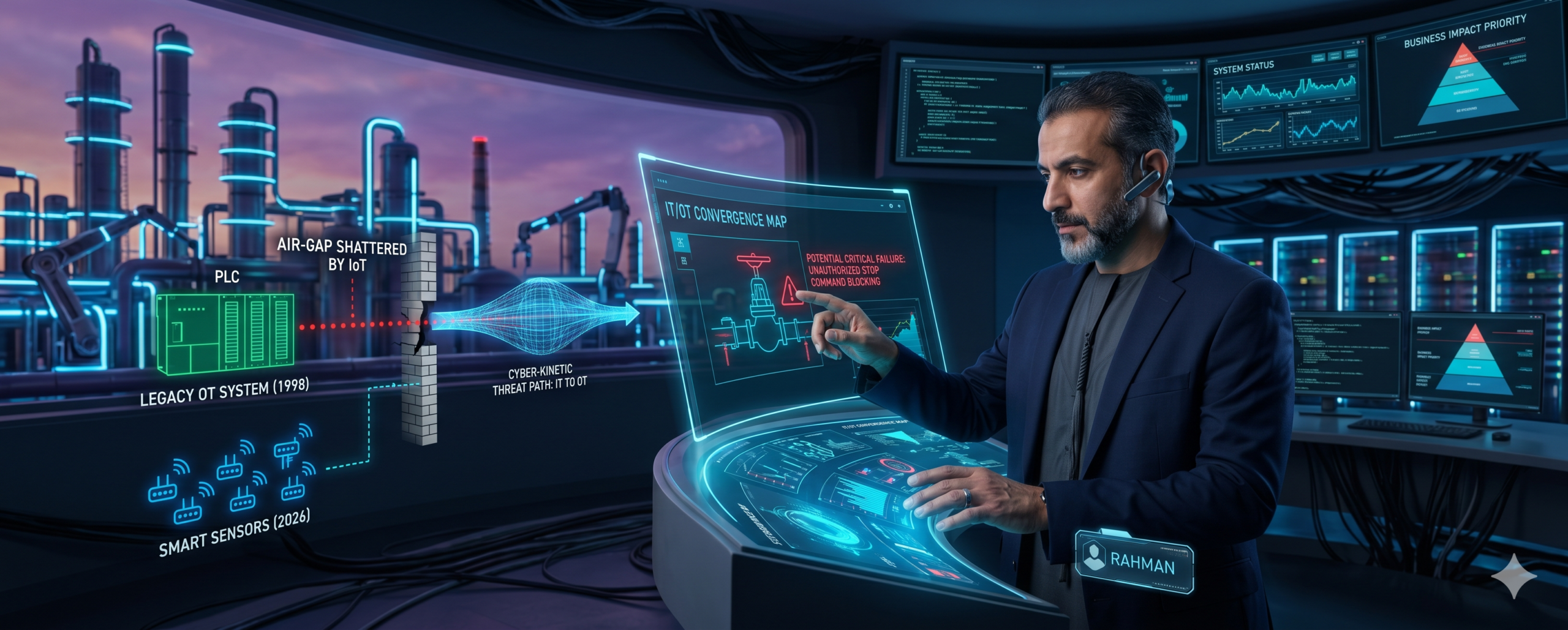
The Kinetic Frontier: Securing the Blurred Line Between IoT and OT
Introduction
For over half a century, the worlds of Information Technology (IT) and Operational Technology (OT) existed in parallel universes. IT managed the flow of data—emails, databases, and websites—while OT managed the flow of the physical world—electricity, water, and manufacturing lines. OT systems were traditionally “air-gapped,” physically isolated from the internet to ensure safety and stability.
However, in 2026, the wall has come down. The rise of the Industrial Internet of Things (IoT) has fused these two worlds into a single, interconnected ecosystem. While this convergence drives unprecedented efficiency, it has also turned every water valve, power turbine, and assembly line into a potential digital target.
1. The Death of the Air Gap
The “Air Gap” was once the ultimate defense. If a machine isn’t connected to the internet, it can’t be hacked. But modern business demands real-time data. To optimize a power grid or a smart factory, sensors must send data to the cloud for AI analysis.
By creating these connections, we have effectively built an “Invisible Bridge” for attackers. A vulnerability in an office printer or a smart thermostat on the corporate Wi-Fi can now be used as a lateral entry point into the Programmable Logic Controllers (PLCs) that run heavy machinery.
2. Kinetic Cybersecurity: From Data Loss to Physical Disaster
In traditional IT security, the worst-case scenario is a data breach or financial theft. In the world of IoT/OT convergence, the consequences are Kinetic—meaning they result in physical motion or damage.
The Vulnerability of Legacy “Dumb” Devices
Much of our global infrastructure runs on hardware designed 20 or 30 years ago. These devices were built for longevity, not security. They use “insecure by design” protocols like Modbus or DNP3, which lack basic encryption or password protection.
When you connect a 1990s-era water pump to a 2026-era IoT network, you are essentially exposing a defenseless machine to a global army of hackers. As hackers target these sensors, they can manipulate chemical levels in water plants, overheat turbines in power stations, or stop production lines in smart factories.
3. OT Security as National Security
Because OT runs the “life support” systems of modern society, it has become a primary target for state-sponsored actors. We are seeing a shift from “smash and grab” ransomware to “Sleeper Cell” positioning.
Strategic adversaries are increasingly infiltrating critical infrastructure not to disrupt it immediately, but to maintain a persistent presence. Their goal is to have “Strategic Leverage”—the ability to disable a city’s lights or water supply at a moment’s notice during a geopolitical conflict. This has elevated OT security from a corporate IT issue to a Top-Tier National Security Priority.
4. The Unified Defense Strategy: Securing the Convergence
Protecting a converged IoT/OT environment requires a specialized “Safety-First” mindset that differs significantly from standard IT security.
Protocol-Aware Deep Packet Inspection (DPI)
Standard firewalls look for “malicious files.” OT firewalls must look for “malicious commands.” Using Deep Packet Inspection, professional teams can monitor the specific industrial protocols used by machinery.
For example, a security system should recognize that a command to “Read Temperature” is safe, but a command to “Format Memory” or “Open Valve 100%” sent from an unauthorized IP address must be blocked instantly.
Passive Network Monitoring
In a factory or power plant, you cannot run active vulnerability scans. If you “ping” a sensitive, older controller too aggressively, it could crash, causing a physical shutdown. Defensive tools must be passive—they “listen” to the network traffic without ever touching the machines, using AI to identify anomalies in real-time.
Network Micro-Segmentation
To prevent a breach in the IT office from reaching the OT factory floor, organizations must implement strict Micro-Segmentation. This creates “electronic perimeters” around every critical asset, ensuring that if a smart sensor is compromised, the attacker is “trapped” in a small segment and cannot reach the main control systems.
Conclusion: Engineering a Resilient Future
The convergence of IoT and OT is the backbone of the “Fourth Industrial Revolution.” It is necessary for sustainability, efficiency, and progress. However, it cannot be sustained without a radical shift in how we view the security of physical things.
At RTC, we understand that in the world of OT, “Uptime is Safety.” We specialize in building the digital armor required to protect the machines that run our world. By combining Passive Monitoring, DPI, and Zero-Trust Architectures, we ensure that the bridge between the internet and the physical world remains a path for innovation, not a gateway for catastrophe.
Critical Questions for Industrial Operators:
- Visibility: Do you have a real-time list of every IoT sensor connected to your machinery?
- Isolation: Is there a physical or logical “Kill Switch” between your office network and your production line?
- Safety: Does your incident response plan account for physical safety and environmental impact, not just data recovery?
- Legacy Management: Which of your 20-year-old controllers are currently exposed to the public internet?