

The Resilience Mandate: Why “Fast Recovery” is the New “Strong Defence”
Introduction
For decades, the cybersecurity industry was obsessed with a single question: “How do we keep them out?” We built taller walls, thicker gates, and more complex locks. But in 2026, the reality of the threat landscape has forced a humble realization: no wall is high enough to stop a determined, AI-driven adversary forever.
The conversation has officially shifted from Cyber Protection to Cyber Resilience. It is no longer a question of if a breach will occur, but when—and more importantly, how fast your business can stand back up after the blow.
1. Defining Cyber Resilience: The Art of the Bounce-Back
While cybersecurity focuses on preventing an attack, Cyber Resilience focuses on business continuity. It is the ability of an organization to anticipate, withstand, recover from, and adapt to adverse conditions, stresses, attacks, or compromises on systems.
In a resilient organization, a ransomware attack isn’t a business-ending catastrophe; it is a temporary operational hurdle. The goal is to move the recovery timeline from weeks and months down to minutes and hours.
2. The Pillar of Immutability: Protecting the Last Line of Defense
In modern ransomware attacks, hackers no longer just encrypt your live data; they go after your backups first. If your backups are deleted or encrypted, you are forced to pay the ransom.
Immutable Backups
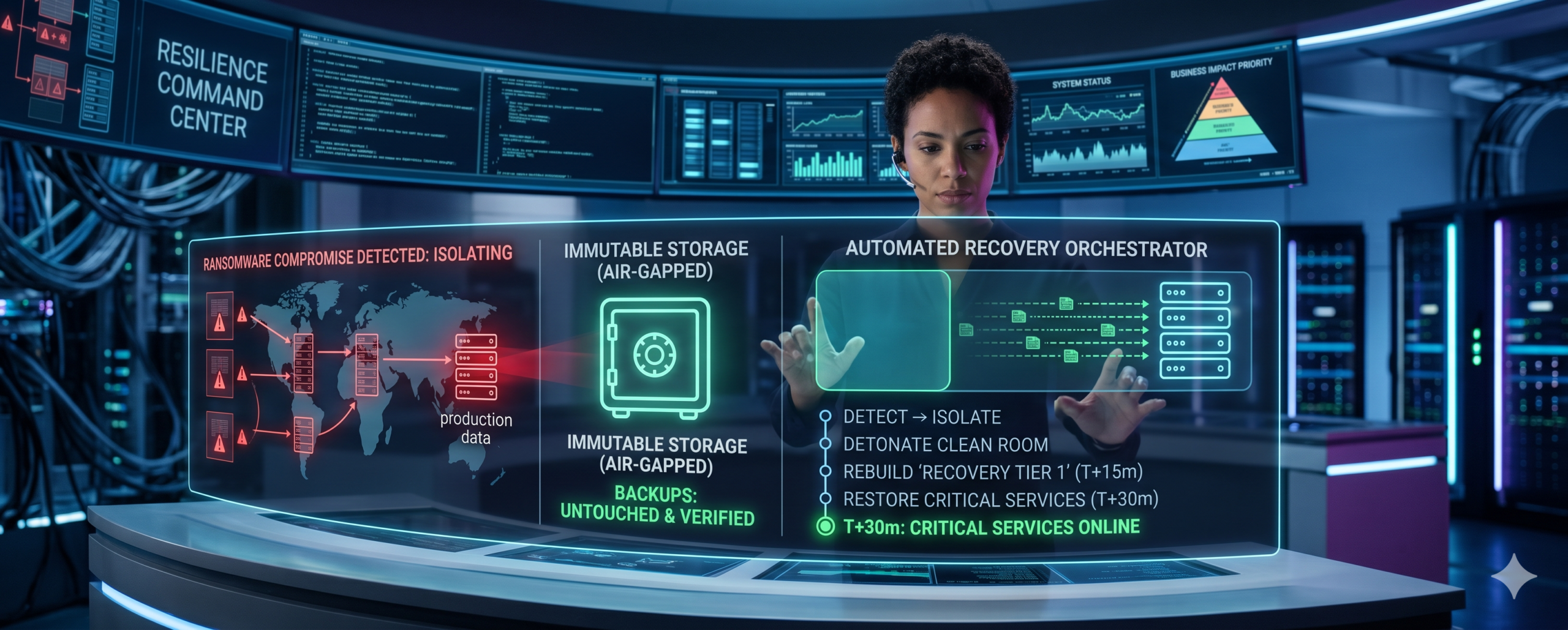
The cornerstone of resilience is Immutable Storage. This is data that, once written, cannot be modified, deleted, or overwritten for a set period—even by someone with administrative privileges.
By maintaining an “Air-Gapped” or immutable copy of your data, you ensure that even if an attacker gains “God Mode” access to your network, your “Last Line of Defense” remains untouched. You don’t negotiate with attackers when you can simply hit “Restore.”
3. Automated Recovery: Fighting Machine Speed with Machine Speed
When a crisis hits, human error is your biggest risk. Manual recovery—finding the right tapes, re-imaging servers, and checking data integrity—is too slow for the modern economy.
Recovery as Code
Resilient organizations utilize Automated Recovery Scripts (often called “Infrastructure as Code” for Disaster Recovery). In the event of a total system wipe:
- The system automatically detects the compromise.
- It triggers a “Clean Room” environment (a safe, isolated cloud space).
- Automated scripts rebuild the entire server architecture from scratch.
- Data is fed back in from immutable backups.
This process, which once took a team of engineers several days, can now be executed by an automated “orchestrator” in under thirty minutes.
4. The Shift in Executive Mindset: From IT to Boardroom
Cyber resilience is not just an IT project; it is a Business Strategy. It requires a shift in how leadership views risk.
- Acceptance of Breach: Leadership must move away from the “Blame Culture” of a breach and move toward a “Readiness Culture.”
- Testing for Failure: Resilient teams don’t just back up data; they practice failing. They run “Chaos Engineering” simulations where systems are intentionally broken to see if the automated recovery actually works.
- Prioritizing Criticality: Resilience acknowledges that you can’t save everything at once. You must have a “Tier 1” list of essential services that must be online within minutes, while “Tier 3” services can wait for 24 hours.
Conclusion: Engineering for the Inevitable
In 2026, a “Secure” company is a company that is prepared to be hit. The shift to Cyber Resilience is an admission of reality, but it is also a source of massive competitive advantage. While your competitors are offline for weeks following an incident, your resilient infrastructure allows you to maintain customer trust and operational integrity.
At Right to Connect, we don’t just build walls. We build systems that know how to heal themselves. We help you move beyond the fear of the breach and into the confidence of resilience—ensuring that no matter what the digital world throws at you, your business keeps moving forward.
Your Resilience Checklist:
- Immutable Backups: Do you have data that cannot be deleted by an admin?
- Clean Room Recovery: Do you have a safe place to restore data without re-infecting it?
- Automated Orchestration: Can you recover your top 5 critical services without manual intervention?
- Regular Drills: Have you actually tried to “restore from zero” in the last six months?