

The Great Algorithmic Arms Race: AI vs. AI in Modern Cybersecurity
Introduction
In the digital landscape of 2026, the battlefield has shifted. The days of human-led phishing campaigns and static malware signatures are rapidly becoming artifacts of the past. Today, we are witnessing the emergence of a new era: The Great Algorithmic Arms Race.
This is no longer a battle of human wit against digital code; it is a high-speed, autonomous conflict where Artificial Intelligence is both the weapon and the shield. As we move deeper into this decade, the survival of an organization’s digital infrastructure depends entirely on which side of the AI equation they can master.
1. The Offensive: The Rise of Polymorphic Adversaries
For decades, cybersecurity was a game of “cat and mouse.” Defenders would identify a malware signature, and attackers would tweak it. Today, that “tweak” happens automatically, thousands of times per second.
The Evolution of Malware
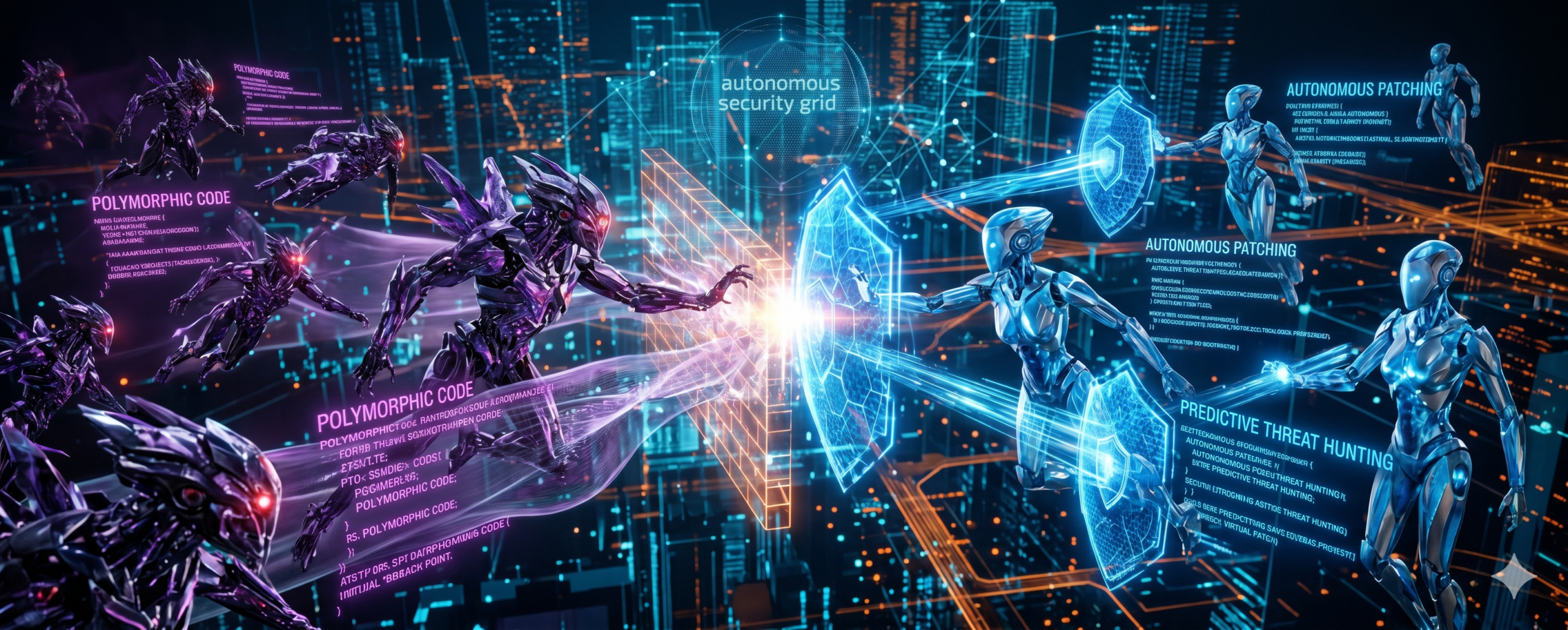
Cybercriminals have moved far beyond the simple use of LLMs for writing convincing phishing emails. They are now utilizing specialized, uncensored models to develop Polymorphic and Metamorphic Malware. Unlike traditional viruses, these AI-driven threats can rewrite their own source code as they move through a network. By changing their digital DNA at every hop, they become invisible to traditional antivirus and EDR (Endpoint Detection and Response) tools that look for known patterns.
Automated Vulnerability Hunting
Offensive AI is now capable of performing “fuzzy” testing at a scale previously unimaginable. Threat actors deploy autonomous agents that scan global networks, identifying zero-day vulnerabilities and crafting custom exploits in real-time. This reduces the “dwell time” between the discovery of a flaw and its weaponization from weeks to seconds.
2. The Defensive: The Rise of the Autonomous SOC
As the speed of attacks approaches “machine speed,” human intervention becomes the primary bottleneck in security. A human analyst takes, on average, several minutes to triage an alert; an AI attacker can compromise a server in milliseconds. To counter this, the industry has birthed the Autonomous Security Operations Center (ASOC).
From Detection to Prediction
Modern defense is moving from reactive to predictive. Defensive AI models are no longer just looking for “bad things”; they are learning the “normal” behavior of every user, device, and data packet on a network.
When a breach begins, the Autonomous SOC doesn’t just send an email to a human—it acts. It can instantly isolate a compromised laptop, revoke a user’s credentials, and reconfigure firewall rules before the malware has a chance to spread. This is the era of Self-Healing Networks.
Autonomous Patching
One of the most significant breakthroughs is AI-driven vulnerability management. Defensive agents can now identify a vulnerability in a company’s code, write a temporary “virtual patch,” and deploy it across the infrastructure automatically. This closes the window of opportunity for attackers before they can even begin their scan.
3. The Future: Maintaining the Strategic Edge
The reality of 2026 is that AI-driven attacks are a “when,” not an “if.” For organizations looking to stay ahead in this arms race, the strategy must be three-fold:
- Embrace Hyper-Automation: You cannot fight machine-speed attacks with manual-speed defenses. Investing in AI-native security tools is no longer optional; it is the baseline for entry.
- Focus on Data Integrity: AI is only as good as the data it trains on. Protecting your security logs from “Data Poisoning”—where attackers feed fake data to your AI to blind it—must be a top priority.
- The Human-Centric Loop: While the AI handles the speed, human experts must handle the strategy. The role of the “Cyber Agent” has evolved from a button-pusher to a high-level strategist who governs the AI’s rules of engagement.
Conclusion
The “AI vs. AI” era is the most transformative period in the history of information security. While the offensive capabilities of AI are terrifying in their speed and adaptability, the defensive potential is equally revolutionary.
In this new world, the winners will be those who don’t just use AI as a tool, but who build their entire security philosophy around the speed, precision, and autonomy of intelligent systems. The race is on, and at Right to Connect, we are ensuring our partners are not just participants—but leaders.
Key Takeaways for Your Team:
- Offense: AI now generates malware that can “think” and change its shape to bypass detection.
- Defense: Autonomous SOCs provide 24/7 protection that acts in milliseconds to isolate threats.
- Strategy: The goal is no longer just “protection,” but “resilience” through automated recovery and prediction.